
How Much Exercise Do You Need? What the Research Says

About one in four adults worldwide does not get the minimum amount of exercise the World Health Organization recommends. Among teenagers it is more than three in four. Those are the figures the WHO guideline authors cite in the 2020 edition, and they have been a stubborn feature of public health data for years.
Most people know they should move more. What they rarely get is a straight answer to the practical questions: how much is enough, what happens if you fall short, and whether a lot more is a lot better. This piece goes through what the main guidelines and a few large studies actually say. Where we are giving our own opinion instead of a finding, we say so.

What the guidelines actually ask for
The WHO 2020 guidelines, published in the British Journal of Sports Medicine (Bull and colleagues), tell adults to do 150 to 300 minutes of moderate-intensity activity a week, or 75 to 150 minutes of vigorous activity, or an equivalent mix of the two. They add muscle-strengthening work that covers the major muscle groups on two or more days a week.
Canada’s 24-Hour Movement Guidelines for adults aged 18 to 64, published in 2020 in Applied Physiology, Nutrition, and Metabolism (Ross and colleagues), set a similar floor of at least 150 minutes of moderate to vigorous aerobic activity a week, plus muscle-strengthening at least twice a week. They also look at the rest of the day: no more than 8 hours of sedentary time, no more than 3 hours of recreational screen time, breaks from long stretches of sitting, and 7 to 9 hours of good-quality sleep.
Notice what is missing from both. Neither one says you have to train hard, join a gym or play a sport. The WHO also states that replacing sedentary time with activity of any intensity, including light activity, has health benefits.
The first steps count the most
If 150 minutes sounds like a lot, the best-known dose-response study is encouraging. In 2015, Arem and colleagues pooled six large US cohorts in JAMA Internal Medicine: 661,137 adults with a median age of 62, followed for a median of 14.2 years, during which 116,686 people died.
Compared with people who reported no leisure-time activity, those who did something but less than the recommended minimum had a 20% lower risk of dying during follow-up (hazard ratio 0.80). People at one to two times the minimum had a 31% lower risk (0.69), and those at three to five times the minimum had a 39% lower risk (0.61). Beyond that the benefit leveled off. At ten times the minimum or more, the ratio was 0.69, and the authors found no evidence of harm.
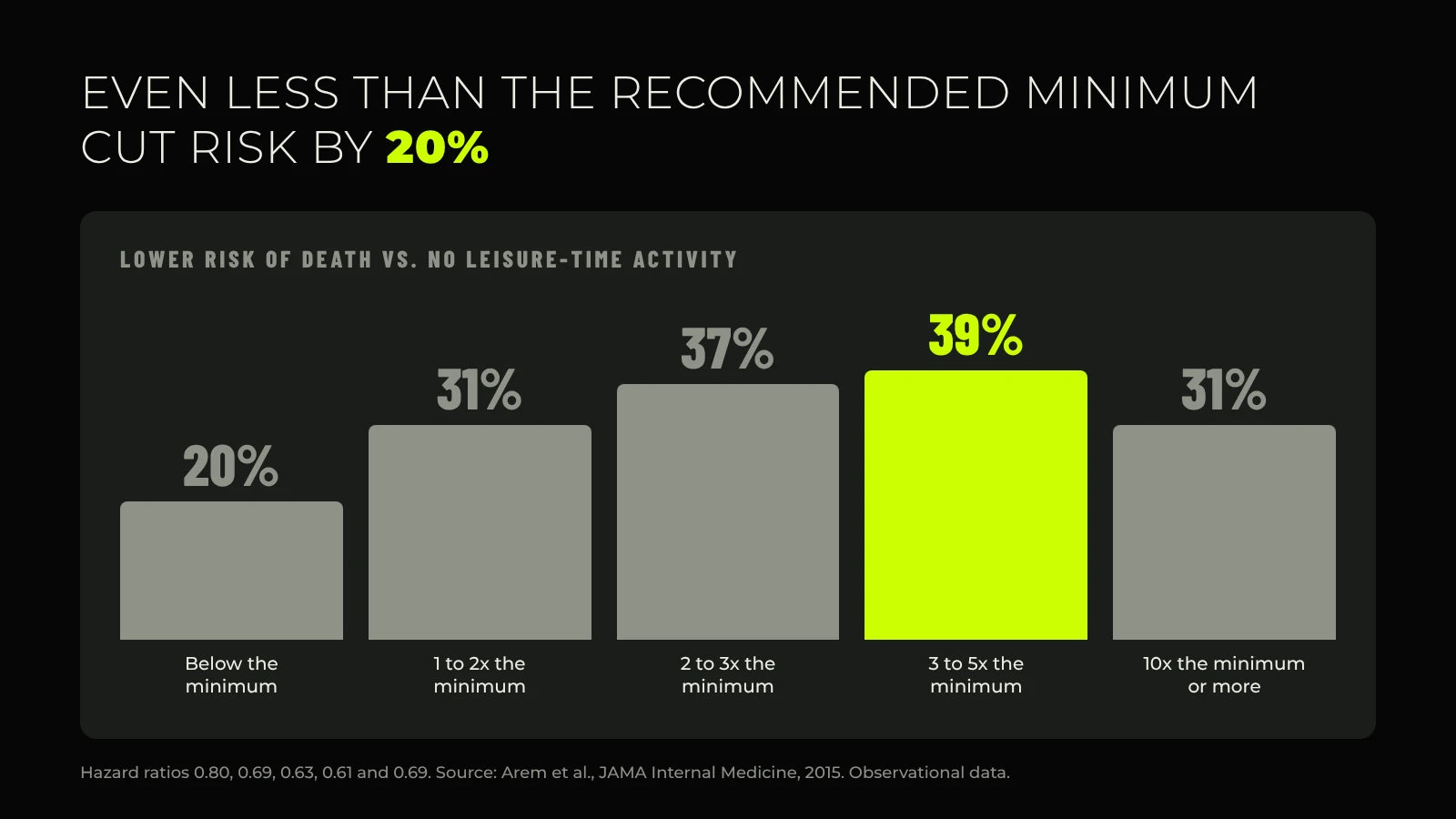
There are limits to what this can tell us. Activity was self-reported, the study is observational, and healthier people are more likely to exercise in the first place, so it shows an association and not proof that exercise caused the difference. Still, the shape of the curve matters. The biggest drop comes between doing nothing and doing something, which is a good argument for starting small instead of waiting until you can do the full 150 minutes.
What it does for your mood

A 2023 overview by Singh and colleagues at the University of South Australia, in the British Journal of Sports Medicine, pulled together 97 systematic reviews covering 1,039 trials and 128,119 participants. Physical activity was linked with lower symptoms of depression (a median standardized effect of -0.43) and anxiety (-0.42) compared with usual care.
A few details are worth knowing. For depression, strength training had the largest median effect (-0.64), ahead of aerobic exercise (-0.45), and higher intensity did better than lower. For anxiety, yoga and other mind-body activities had the largest effect (-0.42). Shorter programs of 12 weeks or less showed bigger effects than longer ones, which the authors found counterintuitive and think may partly reflect how well people stick with a program.
The caveats are real, and the authors state them. Most of the included reviews (77 of 97) were rated critically low on a quality appraisal tool, participants could not be blinded to being in an exercise program, and the comparisons were mostly against usual care, not against therapy or medication. This is not a case for replacing treatment with a run. It is a case that movement is worth including, and that the kind you will keep doing beats the kind that sounds best on paper.
Sitting less counts too
The Canadian guidelines treat sleep, sitting and exercise as one 24-hour picture, and we think that is the most useful way to look at it. A person who trains for an hour and then sits for ten hours, sleeping five, is not in the same place as someone who is moderately active, breaks up the workday and sleeps well. The guidelines suggest breaking up long periods of sitting as often as possible, and the WHO says any activity in place of sitting helps.

A realistic week
This is our own sketch, built on the numbers above. It has not been tested as a program.
- Start where you are. If you do nothing now, ten minutes of brisk walking most days is a legitimate first step, and the pooled data suggest the early minutes carry a lot of the benefit.
- Work toward 150 minutes of moderate activity, which is about 30 minutes on five days. Moderate means you can talk but not sing.
- Add two short strength sessions. Squats, push-ups, rows and carrying heavy things all count.
- Pick something you enjoy enough to repeat: a pickup game, a run club, a bike commute, a dance class. Adherence is the part most programs fail on.
- Stand up and move for a couple of minutes every hour or so, and protect your sleep.
If you have a heart condition, a recent injury, are pregnant, or have not been active for a long time, check with a doctor or physiotherapist before ramping up.
A note on products
We make shoe care products at MR.KICS, including a 2-in-1 grip and clean spray, so weigh this article accordingly. Nothing above depends on buying anything. The evidence says the most valuable thing you can do is show up, and the rest is detail.
Frequently asked questions
How much exercise do adults need per week?
The WHO recommends 150 to 300 minutes of moderate activity or 75 to 150 minutes of vigorous activity, plus muscle strengthening on two or more days. Canada’s guidelines set a minimum of 150 minutes of moderate to vigorous activity and strengthening at least twice a week.
Is a little exercise better than none?
In the large pooled study by Arem and colleagues, people who did less than the recommended minimum still had a 20% lower risk of death during follow-up than people who did none. It is an observational finding, but it points the same way as the WHO statement that any activity brings some benefit.
Does exercise help with depression and anxiety?
The 2023 overview found moderate reductions in symptoms compared with usual care, with the largest effects for strength training in depression and for mind-body activities in anxiety. The quality of many underlying reviews was low, so treat it as a promising add-on and not a replacement for professional care.
Made by athletes, for athletes, in Toronto
We build gear and write about what keeps you playing and moving. See what we are up to on our site.
Sources
- Bull F.C., Al-Ansari S.S., Biddle S., et al., World Health Organization 2020 guidelines on physical activity and sedentary behaviour, British Journal of Sports Medicine 54(24):1451-1462, 2020
- Ross R., Chaput J.-P., Giangregorio L.M., et al., Canadian 24-Hour Movement Guidelines for Adults aged 18-64 years and Adults aged 65 years or older, Applied Physiology, Nutrition, and Metabolism 45(10):s57-s102, 2020
- Arem H., Moore S.C., Patel A., et al., Leisure time physical activity and mortality: a detailed pooled analysis of the dose-response relationship, JAMA Internal Medicine, 2015
- Singh B., Olds T., Curtis R., et al., Effectiveness of physical activity interventions for improving depression, anxiety and distress: an overview of systematic reviews, British Journal of Sports Medicine 57(18):1203, 2023
About MR.KICS: made by athletes, for athletes, in Toronto, Canada. This article is for general information and is not medical advice.
The images in this article are AI-generated illustrations.